Why a Short Loop Can Feel Like a Full Outing
A short loop can make limited free time feel purposeful: choose a visible return point, notice landmarks, and turn back without chasing distance.
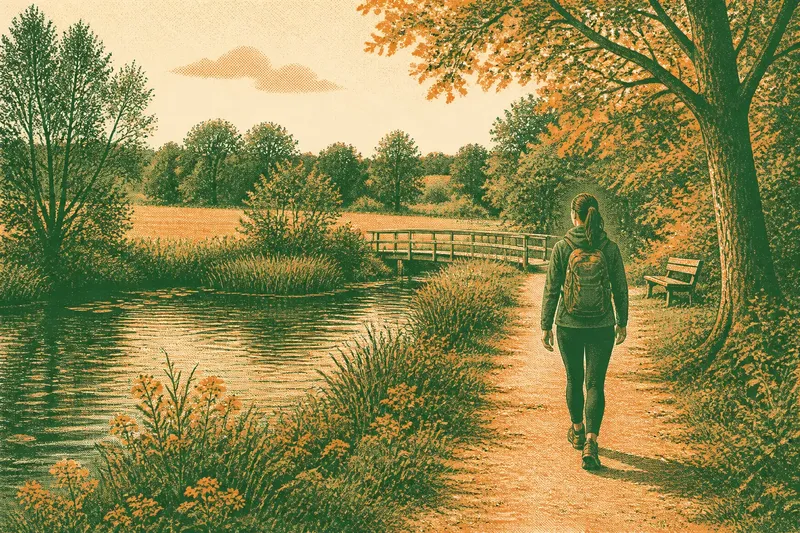
The most common mistake with a short walk is treating distance as proof that it was worth leaving home. That can turn a spare half-hour into a rushed march, with the return trip feeling like an afterthought. A short loop can feel like a full outing when it has a clear shape: a place to head toward, something to notice along the way, and a natural cue to turn back.
What makes a short loop feel complete?
A route feels complete when its parts make sense together, not when it reaches a particular distance. The walk has a beginning, a small destination or turning point, and a return that brings you back to where you started. That simple arc gives limited time a purpose without requiring a grand view or a demanding trail.
Think of the outing as a small change of scene rather than an exercise target. A path beside a stream, a block around a pocket park, or a paved loop in a local preserve can all provide that change. The point is to arrive somewhere and return with your attention having settled into the surroundings.
A loop does not have to be circular. A short out-and-back route works just as well if the turning place is clear and the return feels like part of the plan. A footbridge, an open bench, or the edge of a pond can serve as that marker.
Choose a route with a visible ending, not an ambitious one.
How do I choose a route for limited time?
Start with the time you can comfortably give the whole outing, including getting to the route and returning to your next responsibility. Then choose a familiar public path or neighborhood route where the return point is easy to recognize. You do not need to estimate every minute; you do need to avoid a route whose far end is unclear.
Look for a place where the route offers a natural pause. A boardwalk bend, a playground boundary, a grove at the edge of a field, or a bridge over a drainage channel can give you a reason to stop and turn around. These features make the outing feel chosen rather than cut short.
Keep the access simple. A nearby trail entrance, a park path reached on foot, or a loop around a familiar green space usually suits a brief opening in the day better than a destination that needs elaborate coordination. If the route has several forks, select one branch before setting out so choosing directions does not consume the time you meant to spend outside.
Say you have a free stretch before dinner and a neighborhood path runs past a small pond. You decide that the wooden footbridge is the turning cue, walk there at an easy pace, pause to watch the water, then return by the same path. The expected result is a compact outing with a clear center and ending, even if the walk itself is modest.
Which landmarks make a good turning cue?
A useful landmark is easy to identify from the path and easy to remember on the way back. It can be natural, such as a distinct bend in a creek, or built, such as a trail junction sign, a footbridge, or a picnic shelter. The best cue is not necessarily the most impressive feature; it is the one that makes the route’s endpoint unmistakable.
Pick one main cue and, if the route is unfamiliar, one earlier marker. The earlier marker helps you notice how far you have gone without checking a map repeatedly. A stand of tall trees before a bridge, for instance, can tell you that the turning point is near.
Avoid choosing a cue that depends on a detail you might miss, such as a particular bird, a temporary event, or a sign that can be hidden by other visitors. A stable feature gives the route a dependable shape. On a familiar path, even a simple change in surface or a clearly marked junction can be enough.
Notice one detail at the landmark before turning: the sound under the bridge, the view across the pond, or the shift from gravel to pavement. That pause distinguishes the destination from a mere point on a map.
How should I decide when to turn back?
Use a cue you can recognize without calculating distance. You might turn at a bench beneath a distinctive tree, when the path reaches an open field, or when the route meets a marked junction. A time cue can help too: decide to head home when the outing reaches its planned midpoint, leaving room for the return.
Do not make the turning point a test of resolve. If the path is busier than expected, the weather changes, or you feel ready to head back, returning early still completes the outing. The route’s purpose is to offer a useful break, not to make you earn your way home.
For a very brief walk, the turn can be as simple as reaching a familiar corner and taking a moment before retracing your steps. For a longer window, you might follow a park loop that reconnects with its entrance. Either way, the return point should be clear before you begin, so you can give your attention to the walk rather than negotiating with yourself about how much farther to go.
When the return route is the same path, look for a different view on the way back: the slope behind you, a window of sky between branches, or the direction a stream bends. The familiar route can feel newly legible from the opposite direction.
How can I keep a short walk from feeling rushed?
Leave a little room for the walk to unfold. Setting a destination does not mean walking quickly toward it; it means knowing where you intend to turn. A relaxed pace lets small details register and makes the return feel like another part of the outing rather than a hurried exit.
Choose one kind of thing to notice instead of trying to observe everything. You could pay attention to water sounds, the shapes of tree branches, changes in shade, or how the path’s surface shifts. This is not a task list. It is a light focus that gives your mind somewhere to rest while you walk.
Pause where pausing is comfortable and does not block the path. A bench, a wide trail edge, or an open place beside the route can make a natural stopping point. If there is nowhere convenient to linger, simply slow down for a few steps and look around.
Keep your plan small enough that an interruption does not spoil it. If you have to shorten the route, the first landmark can become the turning cue. If you have more time than expected, you can take a brief pause at the planned endpoint without adding another destination.
What if the route is unfamiliar?
For a first visit, choose a marked route with an entrance and return path that are easy to identify. Read posted signs at the trailhead, note the direction you came from, and use a clear junction or prominent feature as the turnaround cue. A short route is easier to enjoy when you are not uncertain about where it leads.
On a shared path, keep to the side indicated by local signs and allow room for other walkers, cyclists, or mobility devices. If the route has uneven ground, steep sections, or areas that may close, choose a path suited to your abilities and check posted notices. Follow the route’s signs and any applicable local guidance.
A familiar setting can also help: a public park with a visible entrance, a paved path near a community garden, or a neighborhood sidewalk that loops around a green space. You can still make the outing purposeful by selecting one landmark and giving the return a clear cue.
Why does the return matter?
The return is what gives a short route its satisfying shape. Without it, a walk can feel like a fragment: you stepped out, but there was no clear point at which the outing turned toward home. A known return path lets you stop planning and be present with the place.
Returning along the same route is often useful because the way back is already understood. It also makes the walk feel different without requiring another destination: the same bridge, wall, or line of trees appears from a changed direction. On a loop that reconnects with its starting point, the return can instead offer a quiet sense of completion.
Give the ending a small sign of closure. You might take a last look at the landmark, notice the point where the path meets the street, or pause at the park entrance before heading on. It is a modest gesture, but it can help distinguish an intentional outing from simply walking until you run out of time.
Can a short loop work in any season?
The same route can feel different as light, leaves, and weather change. A summer walk may be shaped by shade and birdsong; in a colder season, the focus might shift to bare branches, wet pavement, or the sound of wind across an open area. The route need not change for the outing to have a different texture.
Adapt the turning cue to what is visible and comfortable. A landmark hidden by foliage may be less useful in one season, while a path edge or a distinctive structure remains easy to spot. If conditions make the route unpleasant or uncertain, choose a more sheltered public path or shorten the walk.
Keep practical needs in view without turning a brief outing into a packing project. Appropriate footwear and clothing for the path and weather matter more than carrying items for every imagined possibility. For route access, closures, or restrictions, follow posted signs and local guidance.
How do I make the habit easy?
Attach the loop to a moment that already exists in your day: after lunch, before picking someone up, or when you want a pause between indoor tasks. Reusing a familiar route removes the repeated decision about where to go. You can vary the landmark or the direction when you want a small change.
Keep the plan in plain language. “Walk to the footbridge, pause, and return” is easier to remember than a string of turns or a distance target. If you prefer to use a map for an unfamiliar place, check the route before setting out and then let the visible path guide you.
A short loop can feel like a full outing because it gives a small opening in the day a beginning, a destination, and a return. Pick a landmark that is easy to recognize, let it set the turnaround, and leave enough room to notice the walk itself. The best route is often the one you can begin without making the rest of the day harder to manage.