The Overpacking Habit: Why Every What-If Does Not Need Its Own Item
Outdoor outing packing gets easier when each item earns its place through a specific use, so you can carry what fits the plan without packing for every what-if.
The common outdoor outing packing mistake is giving every imagined inconvenience its own item. The cost is a bag full of duplicate solutions, harder-to-reach essentials, and gear chosen for possibilities that may have little to do with the outing.
Instead of building a kit around a route or a general idea of being prepared, sort proposed items by the job they would do and whether another packed object already does it. The following five checks keep the focus on packing decisions, not on expanding the plan.
Item purpose
Put each proposed item beside the specific task it would handle. A water bottle is for drinking; a small towel might keep damp grass off your clothes. “Might come in handy” is not yet a job.
Then compare items that address the same need. If you have a reusable bottle, a second container needs a distinct reason to take up space. If nothing comes to mind, leave the duplicate behind.
Keep a short packing note with two columns: item and purpose. An item with a blank purpose column is a prompt to reconsider, not an automatic addition.
Duplicate solutions
Several objects can solve the same small problem. A towel, a picnic blanket, and a folding seat may all offer a place to sit, but the right choice depends on the surface and how you prefer to carry your things.
Ask whether one item can meet the likely need well enough. This is not a rule that every object must serve multiple purposes; it is a way to avoid carrying several answers to the same question.
For a planned stop on dry grass, a towel may be enough. For a wet or rough surface, that choice may not work, so choose a suitable alternative rather than adding every option.
Existing gear
Before adding a new purchase or a special-purpose item, check what is already clean and usable. A reusable bottle, a kitchen container for a snack, or a cotton towel may cover an ordinary need without requiring a separate outdoor set.
Suitability matters more than the label. Consider whether the object is sturdy enough, comfortable to carry, and appropriate for the way you expect to use it; a fragile container, for instance, may be an awkward choice in a crowded place.
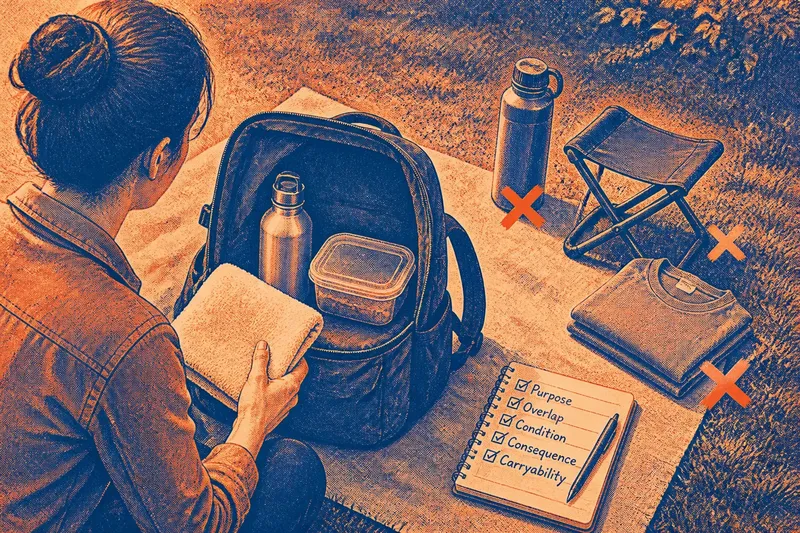
Say you are packing for a relaxed picnic on a nearby lawn, and you have a small backpack, a reusable bottle, a snack container, and a clean towel. You put the bottle, container, and towel in the bag, then leave the separate blanket and picnic kit at home; the resulting tradeoff is a simpler load, with less cushioning and fewer dedicated picnic features.
What-if decisions?
How do I decide if an extra item is useful?
Name the situation it addresses, then ask whether that situation is plausible for the outing and whether something packed already handles it. If the need is vague or duplicated, leave the extra out unless a personal requirement calls for it.
Should I pack a backup for every essential?
Not automatically. Consider the consequence of an item failing and whether a backup is appropriate for the activity; for conditions with meaningful safety implications, follow reliable local guidance and seek qualified advice when needed.
Can household items replace outdoor gear?
They can for ordinary uses if they are clean, sturdy, and suitable for the setting. A towel may work as a sitting layer on dry grass, while a purpose-made option may be more appropriate for a surface where the towel would get wet.
How should I account for changing conditions?
Use the forecast and the specific demands of the place to decide whether an item addresses a likely need. If conditions or the activity require particular equipment, keep that requirement rather than trimming the bag to an arbitrary minimum.
Five packing checks
Use these checks in order when a bag starts filling with extras. Each one asks for an observation and a decision, so an unresolved worry does not quietly become another object.
- Purpose: Check whether you can name a specific use for the item. If you can, pack it; if you cannot, leave it out.
- Overlap: Check whether another packed item serves the same purpose. If one suitable item already covers the need, choose between them; if neither is a suitable substitute, keep the item that fits the conditions.
- Condition: Check whether the item is clean, functional, and appropriate for the setting. If it is, use it; if not, choose a suitable alternative or omit it if the need is not essential.
- Consequence: Check what would happen if you did not have the item. If its absence would affect a safety requirement or an important personal need, plan for it; if the result is only minor inconvenience, consider leaving it behind.
- Carryability: Check whether the item is comfortable to carry and easy to retrieve. If it fits the bag and remains accessible, pack it; if it crowds out more relevant gear, select a smaller suitable option or leave it out.
Imagine you are packing the same picnic kit and notice a second bottle, a folding seat, and a spare shirt beside the bag. You observe that the first bottle is enough for your planned stop, the towel already covers sitting on dry grass, and the shirt has no specific expected use; you leave all three out, but would keep a suitable extra layer if the forecast or your needs made it relevant. The resulting bag has fewer overlapping items, while the decision still changes when conditions do.
A useful reserve
A small reserve can be deliberate without becoming a place for every unresolved what-if. If you often get cold while sitting still, a suitable layer may earn its place; if you tend to use a particular comfort item, that can be a reason to bring it.
After the outing, notice which items came home unused and whether any omitted item would have addressed a real need. That observation can refine your next outdoor outing packing decision without turning one day’s choices into a universal list.